CategoriesGFAN Africa

Celebrating GFAN Africa’s 2023 Achievements: A Year of Advocacy and Progress

Celebrating GFAN Africa’s 2023 Achievements: A Year of Advocacy and Progress

In 2023, the Global Fund Advocates Network (GFAN) Africa marked an extraordinary year, demonstrating remarkable achievements in health advocacy and domestic resource mobilization across the continent. With a focus on collaborative empowerment and strategic advancement, GFAN Africa’s endeavors throughout the year have set a new benchmark for health advocacy in Africa. Here, we reflect on the key milestones and the collective impact of these efforts.


A Unified Voice for Health Financing

GFAN Africa’s engagement with 18 African parliamentarians under the Nairobi Declaration was a landmark initiative, birthing the Regional Parliamentarians Taskforce on Domestic Resource Mobilization for Health in Africa. This body aims at advocating and  emphasizing the significance of domestic resource mobilization for sustainable health financing in Africa. This effort has not only reinforced the commitment of African leaders to health advocacy but has also spotlighted the imperative role of domestic resources in ensuring health equity and access.


Forging Stronger Partnerships for Health

The synergy between GFAN Africa and GFAN Asia-Pacific through the ‘Meet the Target 2.0’ campaign exemplifies the power of cross-regional collaboration. This campaign has been instrumental in sustaining advocacy for a fully resourced Global Fund and advocating for increased domestic resource allocation for health, embodying a collective commitment to universal health access.


Empowering Voices and Engaging Communities

GFAN Africa’s focused efforts on community and civil society engagement, particularly in Kenya and Malawi, underscore the organization’s dedication to amplifying voices at the community level. By facilitating dialogue and community engagement within the ongoing High Level Health Financing Reforms, GFAN Africa has played a pivotal role in shaping health financing reforms that are inclusive and equitable.


Influential Advocacy at Key Global Events

GFAN Africa’s active participation in significant global platforms, including the World TB Day, the World Bank Annual Summit, and ICASA 2023 amongst many other key moments, has amplified its advocacy reach. These events provided vital opportunities to highlight pressing health issues, mobilize support, and influence policy at both regional and global levels.


A Steadfast Commitment to Human Rights

The platform’s united response to the Anti-Homosexuality Act in Uganda exemplifies GFAN Africa’s unwavering commitment to human rights. By mobilizing a collective response and advocating for the rights of marginalized communities, GFAN Africa has reinforced the intrinsic link between human rights and health equity.


Looking Ahead

As we celebrate the achievements of 2023, GFAN Africa remains resolute in its mission to advocate for sustainable health financing and equitable healthcare across Africa. The journey continues, and the network is poised to build on this momentum, driving further progress toward the 2030 global health targets.


GFAN Africa’s 2023 milestones are not just a reflection of the past but a beacon for the future, guiding continued advocacy and collaboration toward a healthier, more equitable Africa. Uniting voices, advocating passionately, to ensure Health For All in Africa.


CategoriesAfNHI

Unlocking the Power of Choice in HIV Prevention

Unlocking the Power of Choice in HIV Prevention


In Harare, Zimbabwe, on the 3rd of December 2023, AfNHi convened the 6th Biomedical HIV Prevention Forum (BHPF) with the support of the BHPF and AfNHi steering committee partners who made the forum a success. The BHPF partners among others included the Advocacy for Prevention of HIV and AIDS (APHA), AIDS Health Foundation (AHF), AVAC,  Frontline AIDS,  Global Network of People Living with HIV (GNP+), HIV Vaccine Trials Network (HVTN), International AIDS Vaccine Initiative (IAVI), International Partnership for Microbicides (IPM), New HIV Vaccines & Microbicides Advocacy Society (NHVMAS), Rwanda NGOs Forum on HIV/AIDS and Health Promotion, Society for AIDS in Africa (SAA), CASPR Partners, WACI Health and partner the Global Fund, CIFF, and USAID.   

  • In her impactful address at the BHPF, Tariro Pamela Mapeto, a young leader from Zimbabwe, shed light on the gaps and opportunities for involving the youth in HIV prevention research. Tariro emphasised the need for meaningful inclusion of young people as equal contributors in crafting solutions tailored to their needs. She highlighted the disproportionate impact on adolescent girls and young women in Sub-Saharan Africa, underscoring the urgent need for their active involvement. Despite the challenges, Tariro asserted that young people possess untapped potential for innovative solutions crucial in the global fight against HIV. Her call to action focused on scaling up interventions such as PrEP, U+U, and self-testing while urging the approval and expansion of newer options like long injectable PrEP and DAPIRing. Tariro emphasised the importance of intentionally creating and sustaining platforms for the voices of Adolescent Girls and Young Women in the HIV response, bridging knowledge gaps through youth-centric channels like social media. Finally, she urged the facilitation of effective support groups to provide safe spaces for young people affected by HIV by: fostering interaction, sharing experiences, and empowerment among peers. Tariro’s call to action resonates as a compelling roadmap for bridging the gap between policy and action in the multifaceted realm of HIV prevention. 

The HIV Prevention Choice Manifesto was envisioned and put together by African women, girls, feminists, and advocates for HIV prevention across Southern and Eastern Africa. United in their call for sustained political and financial commitments for HIV prevention choice.  The Choice Manifesto was visualised following extensive dialogues with funders, governments and communities. At the BHPF, a panel of experts delved into the implications of this manifesto, unravelling its significance and envisioning its impact on the future landscape of HIV prevention. 

Moreover, Grace Kumwenda urged the importance of choice in HIV prevention. She presented the HIV prevention pipeline, which includes long-acting injectables, dual protection pills and ongoing advocacy through the Choice Manifesto. Grace emphasised the importance of quickening the process from product approval to hands-on implementation and addressing structural barriers. Advocating for provider training and investing in healthcare professionals is essential for successful implementation. 

The Partner’s Panel on the future of biomedical HIV prevention, featured insights from key representatives. Mary Latka, from USAID, emphasised collaboration with local governments, donors, and academia, and creating an enabling environment for affordable choices. Anna Rammou, of CIFF, highlighted the importance of choice, emphasising CIFF’s commitment to multi-stakeholder agreements and empowering communities to make informed decisions. Financial diversification and accountability were key considerations for CIFF. Dr. Vuyiseka Dubula, of the Global Fund, emphasised the centrality of communities in their strategy for future prevention options. Community representative, Ruth Akulu, stressed the need for sustainability in HIV prevention, addressing challenges such as gender-based violence and empowering communities to make choices. She advocated for broader participation in research across all African countries to ensure demand and supply alignment for effective solutions. 

Key takeaways from the forum; 

Strengthen Youth Involvement: Actively involve young people in shaping HIV services by letting them express their preferences in terms of services, delivery methods, and locations. Their meaningful participation should be a cornerstone in the planning and execution of Biomedical HIV Prevention (BHP) initiatives. 

Let Communities Lead: Empower communities to take charge of programs designed for them. Decision-making processes within BHP should prioritise the voices and needs of the communities being served, ensuring programs are tailored to their unique circumstances. 

Unlock the Power of Choice: Expand the range of available HIV prevention options. It is crucial to ensure that key populations are not excluded, and affordability must be prioritised to guarantee widespread access to these prevention products. 

Enabling Policy Environment: Remove or amend punitive laws that hinder access for key populations. Create policies and legal frameworks that facilitate the distribution and accessibility of BHP products, particularly to those who need them the most. 

Sustainable Financing: Strengthen domestic resource mobilisation efforts to fund biomedical prevention research. Emphasise the importance of sustainable financing, exploring various funding options to ensure the continued development and accessibility of prevention methods. 

Partnership & Collaboration: Promote collaboration among stakeholders and partners. Strengthen domestic resource mobilisation not only for funding but also for fostering collaboration among diverse entities involved in biomedical prevention research and health funding options.


CategoriesJLA

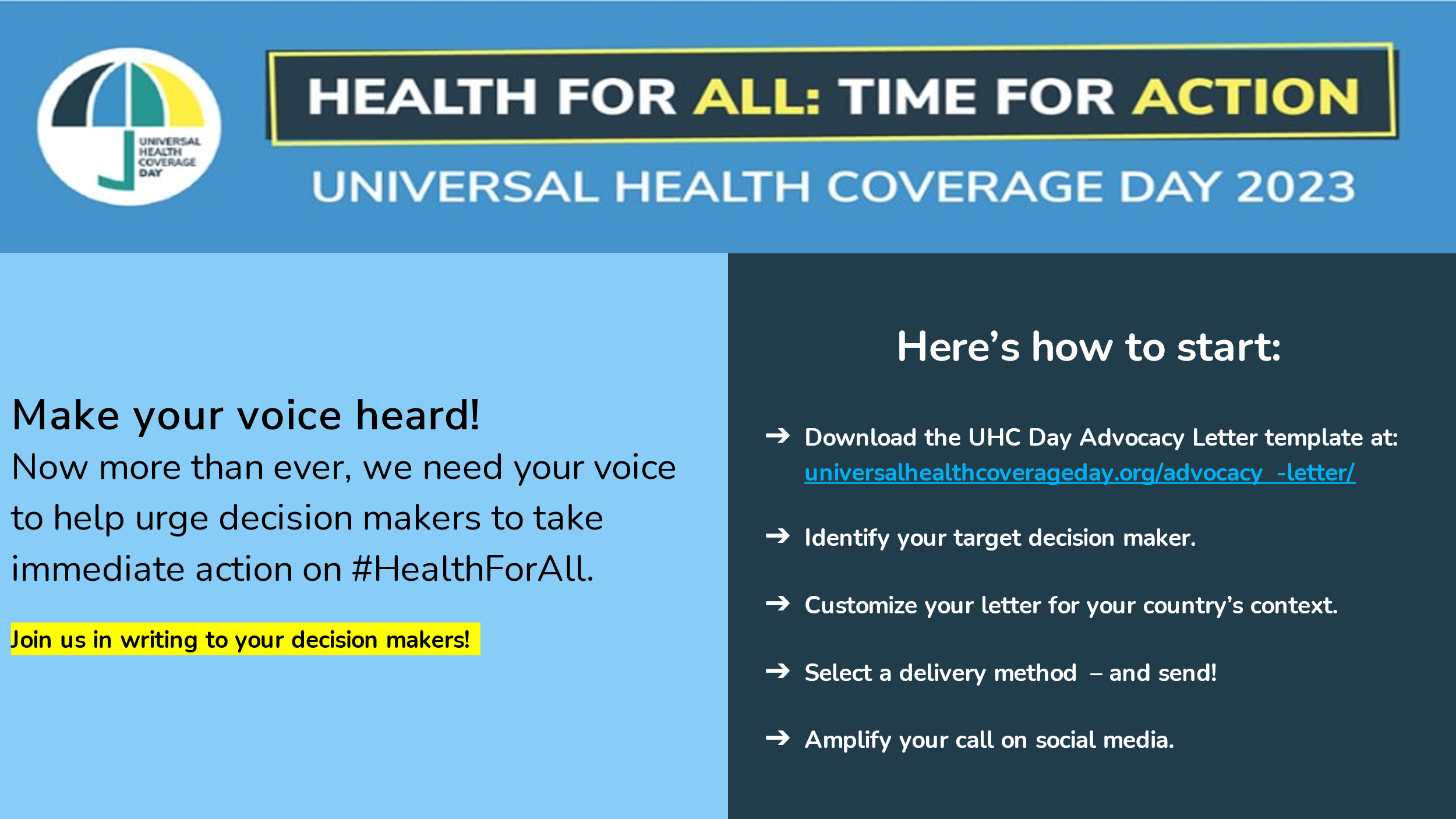
Thank You for Making UHC Day 2023 a Success!

The United Nations High-Level Meeting on Universal Health Coverage (UHC), held on 21 September 2023, reaffirmed that healthy people are the foundation of healthy societies and economies and that UHC is central to achieving all of the Sustainable Development Goals. In the lead-up to UHC Day 2023, we asked you to call on your leaders to act on these commitments.

We’re thrilled to share the energy, momentum, and commitment from the #HealthForAll community: Thank you for making UHC Day 2023 such a success! With dozens of high-level UHC champions, 100+ UHC events and counting, and a flagship town hall event, 12.23.23 has been an exciting milestone for our community to rally together to support health systems that leave no one behind.

On 11 December, we kicked off UHC Day efforts with the town hall event, “Shaping Our Health Future: Young Leaders and Parliamentarians Unite for UHC.”

Read More

UHC Day 2023

CategoriesAfNHI

Standing Together: The Fight for Civil Society’s Voice in ICASA 2023

icasa 2023In a recent turn of events that shook the core of the ICASA 2023 in Harare, the unexpected cancellation of the People’s March, a vital platform for advocacy and awareness, has sparked a wave of disappointment and condemnation among the conference’s participants, Civil Society, activists, and community members. The statement: “Upholding Civil Society Voices in Health International Conferences: A Response to the Suppression and Cancellation of Communities At ICASA 2023 serves as a collective response to this suppression of civil society voices and reflects on the broader context of community treatment since the beginning of ICASA 2023.

CategoriesGFAN Africa

Domestic Resource Mobilization and Achieving Sustainable Health Financing in Africa

The GFAN Africa ICASA 2023 side meeting themed: “Domestic Resource Mobilization and Achieving Sustainable Health Financing in Africa” attended by various stakeholders, including representatives from WACI Health, the Stop TB Partnership Kenya, the Global Fund Secretariat, the Ministry of Health Zimbabwe, and numerous civil society organizations, key discussions unfolded that highlighted both the progress and challenges in the regional and global health sector, particularly in Domestic Resource Mobilization and Achieving Sustainable Health Financing in Africa

Ms. Evaline Kibuchi from WACI Health opened the meeting with a reflective note on the journey thus far. She emphasized the significant strides made in medical research, human rights, and saving lives. Ms Kibuchi pointed out that these achievements were largely due to the relentless advocacy by civil society and the indispensable support of donors. She urged everyone to maintain this momentum to meet the ambitious 2030 targets.

Following her, Mr. Peter Sands from the Global Fund Secretariat took the stage. He acknowledged the pivotal role of community advocates and civil society in reaching health goals. However, he brought to light a critical challenge – the stagnating, and in some places, declining funding for HIV, overshadowed by other global priorities like climate change and civil conflicts. Mr. Sands called for intensified advocacy to keep HIV high on the global health agenda.

The keynote address was delivered by Hon Dr. Douglas Mombeshora, the Minister of Health and Child Care of Zimbabwe. He painted a stark picture of the health crises in Africa, exacerbated by the COVID-19 pandemic. Despite these challenges, he proudly shared Zimbabwe’s success in scaling up HIV prevention and treatment, closely approaching the 95-95-95 targets for adults. He stressed the need for sustainable health financing and innovation in health research and development.

Mr. Itai Rusike from the Community Working Group on Health provided an insightful perspective on the situation in Zimbabwe. He highlighted the substantial support received from the Global Fund and emphasized the crucial role of community involvement in health decision-making. Mr. Rusike also expressed concern over the cancellation of the planned People’s March, viewing it as a limitation on civil society expression.

The open plenary session that followed brought up critical issues regarding the role and challenges faced by civil society in health and human rights advocacy. A collective sentiment emerged. There was a strong call for a unified message to funders and the ICASA Secretariat, emphasizing the need for civil society’s voice and participation in shaping health agendas. A consensus was reached on the use of digital platforms for safe advocacy as well as a strong collective statement on the cancellation of the march and infringement of rights.

This meeting was a testament to the collaborative efforts in the global fight against diseases and the recognition of the hurdles that still lie ahead. It underscored the importance of continued advocacy, strategic funding, and the empowering role of civil society in steering towards the 2030 health targets.


CategoriesGFAN Africa

Biomedical HIV Prevention Forum (BHPF) 2023

Themed: Unlocking the Power of Choice in HIV Prevention Research

The 6th Biomedical HIV Prevention Forum (BHPF) was held on December 3rd in Harare, Zimbabwe as an official pre-conference of ICASA, the forum was hybrid, allowing participants to engage both in-person and virtually. With the theme & Unlocking the Power of Choice in HIV Prevention research," the forum delved into the latest advancements, challenges, and opportunities in biomedical HIV prevention while underscoring the transformative impact of offering a variety of options to make choice a reality. The thematic areas of the forum included i.) sharing on the HIV prevention research pipeline, ii.) exploring investments and funding mechanisms for choice, iii.) introducing the concept of the choice agenda in HIV prevention, and iv.) strengthening African-led advocacy for expanded access to diverse prevention options.

In addition to the main event, mini BHPF events were held in Côte d'Ivoire, Zimbabwe, South Africa, and Rwanda. These events facilitated robust discussions at the country level on unlocking choices in HIV prevention. The discussions and recommendations generated during the forum will be synthesized into an outcome report and blogs, and disseminated to
partners, funders, advocates, and stakeholders to inform and drive further advocacy efforts. BHPF is organized by AfNHi, with technical and financial support from a dedicated steering committee and partner organizations such as APHA, AVAC, CASPR, Children Investment Fund Foundation, Frontline AIDS, GNP+, HVTN, IAVI, IPM, NHVMAS, Rwanda NGOs Forum on HIV/AIDS and Health Promotion, SAA, Alliance Cote d’Ivoire, Rinda UBUZIMA, and WACI
Health. The collaboration underscores the collective commitment to addressing the complexities of HIV prevention and advancing the global goal of ending AIDS by 2030.

CategoriesAfNHI

Empowering Youth: Integrating Sexual and Reproductive Health Education as Gender-Based Violence Prevention

Introduction 

Empowering youth is not just a noble goal; it’s a responsibility we all share in creating a better, more inclusive society. One powerful way to achieve this is by integrating comprehensive sexual and reproductive health (SRH) education into the lives of young people, while also promoting gender-based violence (GBV) prevention. In this article, I’ll share my inspiring journey of taking proactive steps to make this vision a reality by engaging community and religious leaders, as well as law enforcement agencies. These efforts have led to a commitment that can change lives.

Advocacy Journey: September 4th to 7th

The journey towards empowering youth and promoting SRH education as a means of GBV prevention started with an advocacy visit.  During this period, our advocate connected with vital stakeholders within the community, including Community Leaders, Religious Leaders, and the Lagos State Police Force. Their commitment was instrumental in driving this initiative forward.

Community Leaders: Community leaders are the bedrock of our neighborhoods. Their endorsement and commitment to promoting SRH education and GBV prevention within their communities can significantly impact the acceptance and implementation of these vital programs. They understand the unique needs of their communities and can help tailor the messaging accordingly.

Religious Leaders: The influence of religious leaders on the beliefs and practices of their congregations is profound. Engaging with them was a strategic move, as it allowed for the dissemination of these crucial topics within the moral and ethical teachings of the community. Their commitment was instrumental in reaching a wider audience.

Lagos State Police Force: Law enforcement agencies play a pivotal role in addressing and preventing GBV. Collaborating with the police force is crucial in ensuring the safety of young people and providing effective support to GBV survivors.

Outcome of the Advocacy Visit: Community leaders expressed their commitment to support the initiative by allowing access to community spaces for educational workshops, providing resources, and encouraging community members to participate actively.

 Religious leaders expressed their commitment to incorporating SRH education and GBV prevention into their teachings, creating a bridge between faith and knowledge. The Lagos State Police Force committed to providing training for officers on how to handle GBV cases sensitively and efficiently, as well as supporting the initiative by raising awareness about SRH education and GBV prevention among the youth.

Preparation: September 20th and 21st

After securing the support and commitment of these key stakeholders, our advocate shifted focus to gather and organize informational materials, pamphlets, and brochures. These materials were designed to provide straightforward and actionable information about SRH and GBV prevention, along with highlighting the support services offered by the NGO or CSO involved in the initiative.

Informational Materials: Sorting materials that are easy to understand and act upon is critical. These materials cover a wide range of topics, including safe sex practices, consent, reproductive health, and the consequences of GBV. They are designed to resonate with the needs and understanding of young people.

Pamphlets and Brochures: These concise materials are like roadmaps to knowledge and action. They can be distributed in schools, community centers, and religious institutions, making sure the information reaches a diverse audience. These materials serve as both education tools and sources of reference for those seeking help or information.

Support Services: Equally important is making sure young people know where to turn for guidance, counseling, and assistance if they experience or witness GBV. By providing this information, the initiative ensures that young people have access to the help they need when they need it.

Conclusion

Empowering youth through comprehensive SRH education and GBV prevention is a journey filled with hope and positive change. The commitment gained from community and religious leaders, as well as the support of the police force, is a testament to the collective effort to create a safer and more equitable future.

By integrating SRH education and GBV prevention into the lives of young people, we are equipping them with the knowledge and tools to make informed decisions, foster healthy relationships, and contribute to a safer and more equitable society. This advocacy journey isn’t just inspiring; it’s actionable. It shows how individuals and organizations can drive change in their communities, one commitment at a time, ultimately making a lasting impact on the lives of young people. Together, we can empower youth and build a better tomorrow.

Omolayo Ogunyemi Cecilia

AfNHi Youth Mentee 2023

CategoriesAfNHI

Kenya National Pre-UN High-Level Meeting Civil Society Consultation

The Kenya National Pre-UN High-Level Meeting Civil Society Consultation, held on September 12, 2023 in Nairobi, Kenya, was a significant gathering that focused on the global priority of Universal Health Coverage (UHC). With Kenya facing persistent health challenges, including TB ,Malaria ,and HIV/AIDS, the consultation aimed to refine health priorities, strategize for post-UN HLM 2023 engagement, and enhance awareness of human rights and gender concerns. The primary objective was to establish a clear position on inclusivity and the ongoing implementation of UHC, while also creating a framework for holding leaders accountable for the meeting’s decisions and directives.

Opening Remarks

Kenya AIDS NGOs Consortium (KANCO) Executive Director,Allan Ragi, opened the engagement with an acknowledgment of the progress made in the battle against TB and other health-related issues. He shared some insights about the changing landscape of HIV/AIDS in line with Tuberculosis infections while also citing a previous lack of addressing TB-related issues in the early years due to negligible funding. Nonetheless, he acknowledged the progress that has taken place over the years, including increasing donor funding and programmatic support from Kenyan authorities, including the Ministry of Health (MOH), Kenyatta Hospital, and the Health Committee at the Council of Governors (COG). These initiatives have seen the growth of the TB champions movement, with a focus on issues such as drug-resistant TB. At the same time, he emphasized that everyone should aim to make a difference, reminding everyone that ‘you never get it unless you ask for it or identify the issue.’ The emphasis was placed on collective responsibility and collaboration towards making a substantial impact in the health sector.

Overview of High-Level Meeting Processes and Updates

Evaline Kibuchi  The Chief National Coordinator at Stop TB Kenya delivered a comprehensive presentation that detailed the extensive preparations for the upcoming UN High-Level Meeting (HLM) scheduled for September 2023. The presentation emphasized the significant progress and developments that have taken place since the initial TB HLM in 2018. 

During the presentation, there was a thorough exploration of the organization and themes of the HLM, highlighting a shared global commitment to two key priorities: expanding Universal Health Coverage (UHC) and strengthening efforts related to Pandemic Prevention, Preparedness, and Response (PPPR). This indicates a global consensus on the importance of these critical health objectives as part of the UN HLM’s agenda.

Achievements and Commitments

The consultation celebrated Kenya’s noteworthy achievements in reducing new infections and TB-related mortalities from 33,000 in 2019 to 21,000 by 2021, along with its significant progression out of the high MDR-TB countries category. The outlined provisions of the Political Declaration reiterated a commitment to ensuring an all-encompassing, equitable, and people-centered approach in TB responses nationwide.

Inputs from Consultative Meeting with Key Populations

The Consultative Meeting with Key Populations resulted in the presentation of valuable insights, emphasizing the need for more comprehensive and diversified strategies to ensure the continued effective implementation of Universal Health Coverage (UHC). Key populations stressed the importance of addressing specific concerns related to the Lesbians,Bisexuals, Transgender, Queer, Intersex & Gender Non Conforming (LBTQIGNC) communities, along with other vulnerable groups, to ensure their equitable access to health resources and protection. These contributions highlighted the significance of promoting transparency and accountability in national health initiatives, ultimately enhancing the resilience and responsiveness of healthcare systems.

After a thorough review of existing National Health and Human Rights Policies, an assessment of Community-Led Responses, an examination of societal enablers, and an evaluation of external support and investments, the following key action points were identified;

  • Acknowledging diverse perspectives within Civil Society Organizations (CSOs).
  • Advocating for legal reforms to support Key Populations and the LBTQIGNC communities.
  • Documenting achievements to shape evidence-based policies.
  • Promoting community-driven initiatives for healthcare ownership.
  • CSOs monitoring and allocating funds effectively.

These key action points serve as the foundation for a more inclusive and equitable approach to healthcare delivery and policy formulation, ultimately enhancing the well-being and healthcare access of Key Populations and the LBTQIGNC community.

Conclusion

In conclusion, our journey toward fostering true inclusivity and equitable representation for Key Populations and LBTIGNC communities is one that demands our unwavering commitment and persistence. The reflections from our consultative meeting have illuminated essential next steps on this path.

First and foremost, we must recognize that inclusion is intricately linked to the presence of supportive laws and policies, as well as accessible data. These foundational elements are pivotal in our quest for comprehensive reform. Moreover, as we navigate this journey, we must understand that all reforms involve processes. It becomes imperative to ensure that these processes are underpinned by protective laws that safeguard all communities, especially our Key Populations and LBTIGNC communities. 

To operate programs safely and without victimization, we must harness existing safety mechanisms, allocate resources effectively, and uplift those who carry our message. This underscores the urgency of enhancing our safety nets. In our pursuit of inclusivity, we must avoid using language that inadvertently discriminates against sexual and gender minorities. Our conversations and documents should reflect a commitment to eradicating such biases.

The prevailing tendency to exclude communities in planning, policy development, and implementation must change. Communities are urged to push for representation in financial processes and decision-making spaces from grassroots to the national level. To achieve this, we must foster intentional inclusion and meaningful engagement with political representatives and authorities through the proper channels and procedures. Capacity building, particularly through CSOs, is instrumental in this endeavor. Finally, comprehensive guidelines for Community-Led Monitoring (CLM) and monitoring of other diseases and chronic illnesses must be developed, extending beyond HIV care to address the diverse healthcare needs of our communities.

Our journey towards inclusivity and equitable representation is undoubtedly challenging, but with collective dedication and adherence to these vital reflections and next steps, we are poised to effect transformative change and ensure that no one is left behind in the pursuit of better health and well-being.

Fahe Kerubo

AfNHi Mentee 2023


CategoriesAfNHI Article

Adherence To Art Medication And Challenges Faced By Young People Living With HIV

On July 29, 2023, a gathering of young individuals living with HIV became a beacon of strength and support. This support group session was dedicated to addressing the vital topics of antiretroviral therapy (ART) adherence and the challenges faced by young people in accessing HIV services. It provided a safe haven for these resilient souls to exchange experiences, coping strategies, and tales of triumph over adversity. With 24 participants, including eight from the LGBTQIA community, the session was a testament to the power of community and shared resilience.

Session Highlights:

This support group session was an active dialogue, allowing participants to open their hearts and minds freely. Here are the key takeaways:

ART Experiences and Coping Mechanisms:

Participants emphasized the paramount importance of adhering to ART medication for maintaining their health. They shared their personal journeys, shedding light on the various coping mechanisms they’ve employed to navigate challenges such as medication side effects, stigma, and emotional well-being. The session became a platform for these young warriors to exchange strategies and provide mutual support, nurturing a sense of belonging and empowerment.

Challenges in Accessing Services:

The challenges in accessing HIV services emerged as a significant theme. Participants identified barriers such as limited access to healthcare facilities, lack of awareness about available services, and the persistent specter of discrimination and stigma. The LGBTQIA community members shared their unique experiences, unveiling additional layers of obstacles they face. The session encouraged participants to voice their concerns and collectively brainstorm potential solutions.

Success Stories and Achieving Low Detectable Levels:

The session was not just a platform for sharing challenges; it was also a stage for showcasing success stories. Participants narrated their journeys of ART adherence, culminating in the achievement of low detectable levels of HIV infection. These stories served as beacons of inspiration and motivation for others facing similar trials. The session underscored the pivotal role of support networks, healthcare provider relationships, and self-care practices in achieving positive health outcomes.

Conclusion:

In conclusion, this support group session on ART adherence and challenges in accessing HIV services was a powerful forum for young individuals to pool their wisdom and experiences. It illuminated the ongoing need for support, awareness, and advocacy to address the unique hurdles faced by young people living with HIV. By fostering a sense of community and empowerment, the session aimed to ignite a spirit of resilience, encouraging participants to maintain their ART adherence and strive for low detectable levels of HIV infection. In these voices, we find the strength to triumph over adversity, inspiring hope for a brighter future in the face of HIV.

Kelvin Njoroge

AfNHi Youth Cohort Mentee 2023

CategoriesAfNHI Article

Empowering Adolescent Girls and Young Women in Uganda to Combat Workplace Harassment

Recent findings from a study conducted in Uganda reveal alarming statistics: one in three Adolescent Girls and Young Women (AGYW) have suffered physical or sexual abuse, while an even more distressing one in two have experienced sexual harassment. This pervasive violence against AGYW poses a grave concern that demands immediate attention. Such acts of violence not only inflict physical and emotional trauma but also lead to financial hardships, hindering AGYW’s ability to pursue education, employment, and a healthy life.


Addressing this pressing issue, ACTS101 Uganda partnered with UGANENT LAW to organize an empowering event titled “Empowerment to Power,” specifically targeting young women in the workplace. The primary objective of this engagement was to empower AGYW, enabling them to voice their concerns and advocate for measures against workplace violence and abuse. Additionally, it aimed to raise awareness regarding the pervasive issue of violence targeting AGYW in employment settings.


Understanding Body Autonomy and Gender-Based Violence (GBV):

Mrs. Bridget N. Jjuuko, Executive Director of ACTS101 Uganda, initiated the event with a crucial presentation highlighting the significance of body autonomy. Body autonomy emphasizes an individual’s right to make choices about their body without fear of violence or coercion. During the presentation, the six core types of gender-based violence (GBV) were discussed in detail:

  1. Physical Violence
  2. Verbal Violence
  3. Psychological Violence
  4. Harassment and Sexual Violence
  5. Socio-Economic Violence
  6. Domestic Violence


Sharing Personal Experiences:

Following Mrs. Jjuuko’s presentation, AGYW participants were encouraged to share their personal experiences of workplace violence. These stories unveiled the heart-wrenching reality of their daily struggles. For instance:

– One young woman recounted how her boss frequently made inappropriate comments about her appearance, creating an uncomfortable work environment.

– Another young woman revealed that her boss had demanded a kiss, and upon her refusal, unjustly terminated her employment.

– A third young woman, who identifies as transgender, disclosed being physically assaulted by a client.


Understanding Legal Framework and Rights:

The sharing of experiences led to a constructive discussion about the legal framework concerning sexual harassment. Ms. Shakira, a lawyer from UGANENT LAW, advised AGYW participants to carefully review their employment contracts and become aware of their rights. She emphasized the importance of maintaining a journal to document any incidents of harassment and encouraged participants to confide in trusted friends or family members about their experiences.


Charting the Path Forward:

The engagement concluded with a session dedicated to charting a path forward. AGYW participants proposed several actionable steps to address workplace GBV effectively:


  1. Development of a one-page information sheet on GBV within every organization.
  2. Creation of a standard GBV manual tailored to AGYW, facilitating training and awareness.
  3. Drafting a petition to raise awareness about GBV.
  4. Collaboration among civil society organizations to collectively combat this pressing issue.

Conclusion:

The “Empowerment to Power” engagement served as a valuable platform for AGYW to share their workplace harassment experiences and gain insights into their rights. Although significant work remains in addressing this pervasive problem, this event marked a crucial step forward. By empowering AGYW to stand against workplace sexual harassment, we aim to build a more just and equitable society for all, recognizing that AGYW represent the future of Uganda.

Victoria Nalweyiso

AfNHi Youth Mentee 2023