World AIDS Day commemorated each year, is an opportunity for people worldwide to unite in the fight against HIV, to show support for people living with HIV, and to commemorate those who have died from an AIDS-related illness .Founded in 1988, World AIDS Day was the first ever global health day, and organizations and individuals annually endeavor to increase HIV and AIDS awareness and knowledge, speak out against AIDS stigma, and call for an increased response to move toward ending the AIDS Epidemic.
This year’s theme “Equalize” slogan is a call to action. It is a prompt for all of us to work for the proven practical actions needed to address inequalities and help end AIDS.
The Adolescent, Girls and Young Women (AGYW) in Africa remain disproportionately affected by HIV, while coverage of dedicated programmes for them remains too low. AfNHi is committed to giving the young people a platform for their voices to be heard and on this World AIDS Day, the
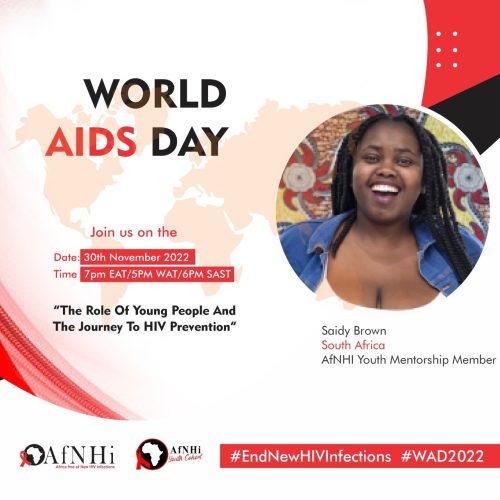
youth cohort commemorated it in line with the global celebration with a live Twitter space themed, “The role of the young people and the journey to HIV prevention”.

Itumeleng Mothlabane based in South Africa kick started the conversation by sharing how young prevention champions in her community, took leadership before, during and after COVID – 19 by going to the clinics and finding a variety of ways to involve young people on discussions and programs targeting prevention and de-stigmatization community strategies.
HIV-related stigma has been increasingly recognized as a key factor impeding HIV identification, prevention, and treatment. Stigma and discrimination impact the way communities, family, and partners interact with young people living with HIV, and undermine public health efforts to combat the epidemic. This is largely due to the negative impact stigma has on primary and secondary preventive behaviors such as condom use, HIV testing, engagement in HIV care, and quality of care.
 Winnie Akidi, an AfNHi youth cohort member based in Uganda, stated that the young people in Uganda are engaged now more than ever through social media, and other platforms such as through beauty peagents for example Y plus which have allowed for a united front on young people voices in creating awareness on HIV prevention.
Evidence shows that where young people are involved in programming, visible effective programme outcomes and services work towards HIV prevention and new HIV infection among young people. As the saying goes, nothing for Us Without Us, it is therefore vital that young people are engaged continuously to support the HIV response, treatment and prevention.
 Saidy Brown, an AfNHi youth cohort member based in South Africa, stated that four decades into the HIV response, inequalities still persist for the most basic services like testing, treatment, and condoms, and even more recently so, for new prevention bio technologies. She did however state that “The future looks bright, given the different options available for HIV prevention. What we deserve is a life free of worry from HIV and provision of a basket of choice will go a long way in meeting community, AGYW needs at the grass root level.
Providing African communities with a variety of acceptable, discreet, and convenient choices for highly effective HIV prevention is imperative NOW, not in the near future. For some people, provision of a buffet of prevention options will allow them to increase the options suitable to them at different points of their lives. As such the need for new women centred HIV prevention options remins a public health , reproductive justice , and human rights imperative.
An estimated 50 adolescent girls die every day from AIDS-related illnesses. And each day, some 460 adolescent girls become infected with HIV. Accountability is critical and we are far behind reaching the Fast-Track Targets for 2020 agreed by all countries in the 2016 United Nations Political Declaration on Ending AIDS. Services for adolescent girls and young women are especially failing to reach those who are falling the furthest behind—adolescent girls and young women who experience gender-based violence, who are sexually exploited or who use drugs, among others.
 Victoria Quaynor, based in Ghana concluded the discussion by highliting that we can not ignore that any form of inequalities has a greater probability to contribute to a slow response to the HIV prevention programs currently available accross Africa. Inequalities on HIV prevention options, inequalities on stigma and discrimination, gender inequalities just to mentinon a few.
Gender inequalities particularly, adolescent girls and young women face discrimination that compounds their vulnerabilities to HIV. They are largely invisible, underserved and underrepresented in policies, services and investments.
When girls can’t uphold their human rights—especially their sexual and reproductive health and rights—efforts to get to zero exclusion, zero discrimination, zero violence and zero stigma are undermined. It is time to break the vicious cycle of gender inequities, gender-based violence and HIV infection, once and for all.
HIV is life changing and not limiting- we are greater than HIV.- inc AfNHi youth cohort mentorship 2022





 In the discussion it was mentioned how in rural South Africa such as Madwaleni , persons with disabilities faced significantly more barriers to accessing health care compared to persons without disabilities. Barriers increased with disability severity and was reduced with increasing level of education, living in a household without disabled members and with age.In the urban cities such as Johannesburg , Gcobisa Madololo informed the team that there are few youths’ friendly facilities that specifically deal with people with disabilities however most facilities are inaccessible for persons with disabilities as they do not have ramps, as well as ill treatments from health providers. This is a major issue that is neglected by advocates and organizations working around SRHR service access and information.
 Having invited key advocates to respond to a question dubbed “REFLECTIVE VOICES ON SRHR ACCESS”, one of the panelists, Charles mentioned how policies have greatly influenced access to SRHR services for young people especially those below 18 years in Uganda. Reflecting on different works done by different members of Civil Society .
 As a passionate gender and disability expert, Shamim mentioned how the barriers are compounded especially with the covid pandemic, caretakers of persons with disability in reproductive age still deny them their SRHR rights without consent where body autonomy is involved. she further mentioned how care takers carry out drastic decisions like abortion and forced sterilization of these person in thought that they incapable of taking care of children since they are disabled. Shamim also mentioned how the physical environments are not friendly and how medical equipment are not designed for examination and labor purposes thus robbing these young women of their dignity.
 There’s a need to be intentional on how to package messaging around SRHR and HIV prevention and awareness. Mentioning how the media needs to be fully engaged in creating awareness.