

Empowering Youth Advocacy for Global Health
In the heart of vibrant Nairobi, a dynamic gathering of 30 young individuals came together in August 2023. These were the champions of tomorrow, belonging to the Adolescent Girls and Young Women (AGYW) cohort. Their mission: to mark World Youth Skills Day with a bang, celebrating the boundless potential of young minds and their pivotal role in shaping our global health future.
This gathering had a clear purpose, and its objectives set the stage for exciting engagement outcomes.
- The participants were on a quest to make the world resonate with the advocacy efforts of the DAPI Ring, both on a national and global scale.
- Foster Inclusivity:- They sought to create an inclusive dialogue, a movement that would resonate far and wide, powered by WithMeInMe.
- Introducing the Choice Manifesto:- An introduction to the Choice Manifesto was on the agenda, igniting the spark of change.
Advocacy on the DAPI Ring: In the spotlight was the imperative of accurate information, dispelling myths, and the fight for free and accessible HIV prevention tools. Also highlighted was the progress of the CATALYST studies in Kenya and the progress of the activation sites to date.

Skills and Empowerment: The power of advocacy skills and communication took center stage. Social media emerged as a mighty weapon for spreading awareness. Evidence-based advocacy was highlighted as a critical tool in modern day advocacy. The participants went ahead and brainstormed around various ways digital media advocacy can amplify the call for inclusion of the DAPI Ring on the HIV Prevention basket of choice.
LGBTQI Inclusivity: The discussions ripped through stigmas, championing equality. Discussions illuminated a critical imperative: dismantling stigmas and dispelling misconceptions surrounding LGBTQI communities. The spotlight was on promoting acceptance and nurturing inclusivity within HIV prevention programs. In this narrative of change, education and awareness emerged as potent catalysts for fostering equality. This collective insight resounded loudly, underscoring the WithMeInMe campaign as a vital platform for meaningful dialogue. It hammered home the urgency of inclusivity and the indispensable role of education in propelling effective change within the realm of HIV prevention efforts.

Global Fund Writing Process:Ruth Jerop, AYAREP Executive Director and a community representative on the Kenya Coordinating Mechanism (KCM), graced us with an update on the Global Fund writing process. She stressed the critical need for the Dapivirine (DAPI) ring, citing past challenges faced by interventions like PEPFAR in effectively combating HIV. Jerop emphasized that the DAPI ring’s potential to empower individuals to take control of their bodies and sexual health has not been fully realized. Urgency looms, and addressing the roadblocks is crucial. She called for a thorough examination and rectification of these hindrances, ensuring that the Global Fund’s financial resources lead to a comprehensive, culturally sensitive implementation strategy. As she concluded her address, Ruth appealed to the young audience to grasp the challenges faced by different demographics to enable the advocacy to be evidence-led.
In the end, this electrifying gathering was a rallying cry for action. The Youth advocates pledged their dedication to HIV prevention, inclusivity, and the continued advocacy of the DAPI Ring. The Choice Manifesto launch scheduled for September 2023 lays a promising secure and effective discussions around the HIV Prevention Choice agenda regionally.
AfNHi Secretariat

 Winnie Akidi, an AfNHi youth cohort member based in Uganda, stated that the young people in Uganda are engaged now more than ever through social media, and other platforms such as through beauty peagents for example Y plus which have allowed for a united front on young people voices in creating awareness on HIV prevention.
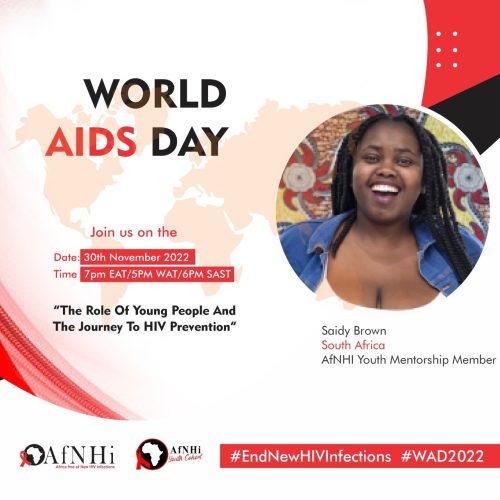
 Saidy Brown, an AfNHi youth cohort member based in South Africa, stated that four decades into the HIV response, inequalities still persist for the most basic services like testing, treatment, and condoms, and even more recently so, for new prevention bio technologies. She did however state that “The future looks bright, given the different options available for HIV prevention. What we deserve is a life free of worry from HIV and provision of a basket of choice will go a long way in meeting community, AGYW needs at the grass root level.
 Victoria Quaynor, based in Ghana concluded the discussion by highliting that we can not ignore that any form of inequalities has a greater probability to contribute to a slow response to the HIV prevention programs currently available accross Africa. Inequalities on HIV prevention options, inequalities on stigma and discrimination, gender inequalities just to mentinon a few.


 In the discussion it was mentioned how in rural South Africa such as Madwaleni , persons with disabilities faced significantly more barriers to accessing health care compared to persons without disabilities. Barriers increased with disability severity and was reduced with increasing level of education, living in a household without disabled members and with age.In the urban cities such as Johannesburg , Gcobisa Madololo informed the team that there are few youths’ friendly facilities that specifically deal with people with disabilities however most facilities are inaccessible for persons with disabilities as they do not have ramps, as well as ill treatments from health providers. This is a major issue that is neglected by advocates and organizations working around SRHR service access and information.
 Having invited key advocates to respond to a question dubbed “REFLECTIVE VOICES ON SRHR ACCESS”, one of the panelists, Charles mentioned how policies have greatly influenced access to SRHR services for young people especially those below 18 years in Uganda. Reflecting on different works done by different members of Civil Society .
 As a passionate gender and disability expert, Shamim mentioned how the barriers are compounded especially with the covid pandemic, caretakers of persons with disability in reproductive age still deny them their SRHR rights without consent where body autonomy is involved. she further mentioned how care takers carry out drastic decisions like abortion and forced sterilization of these person in thought that they incapable of taking care of children since they are disabled. Shamim also mentioned how the physical environments are not friendly and how medical equipment are not designed for examination and labor purposes thus robbing these young women of their dignity.
 There’s a need to be intentional on how to package messaging around SRHR and HIV prevention and awareness. Mentioning how the media needs to be fully engaged in creating awareness.
 Prior to joining HCD Exchange in 2022 I had some level of understanding of HCD. Notably, in 2020, I participated as an interpreter on a Y-Labs project that engaged girls on SRH, specifically youth friendly clinics. Although there are many HCD methods and tools such as Journey Maps, Role play,Storyboard, card sort just to mention a few. One of the tools used by Y-Labs during the session was Card sort through a focused group discussion.
 As a result, my project, SRH Day out, targeted the Shai Osuduko community. Using HCD, we assessed their needs and determined that they required not only reproductive health information but also education support in the form of stationeries. Using the AfNHi youth mentorship project support, my team and I provided a comprehensive response to their needs during the project’s implementation;through SRHR information sharing, provision of stationeries for students, career guidance and mentorship. This way, the people of Shai Osuduko, chiefly, the young people’s needs would be met.
