Following the Money: Rwandan Civil Society Builds a Coalition for Health Financing
African governments have made many commitments on health financing, including the Abuja Declaration, the ALM Commitment and various institutional frameworks aimed at increasing domestic allocations for health. But a commitment on paper only becomes healthcare when money is allocated well, released on time, spent as intended, and audited by the end-users of health programmes. That is Public Financial Management (PFM).
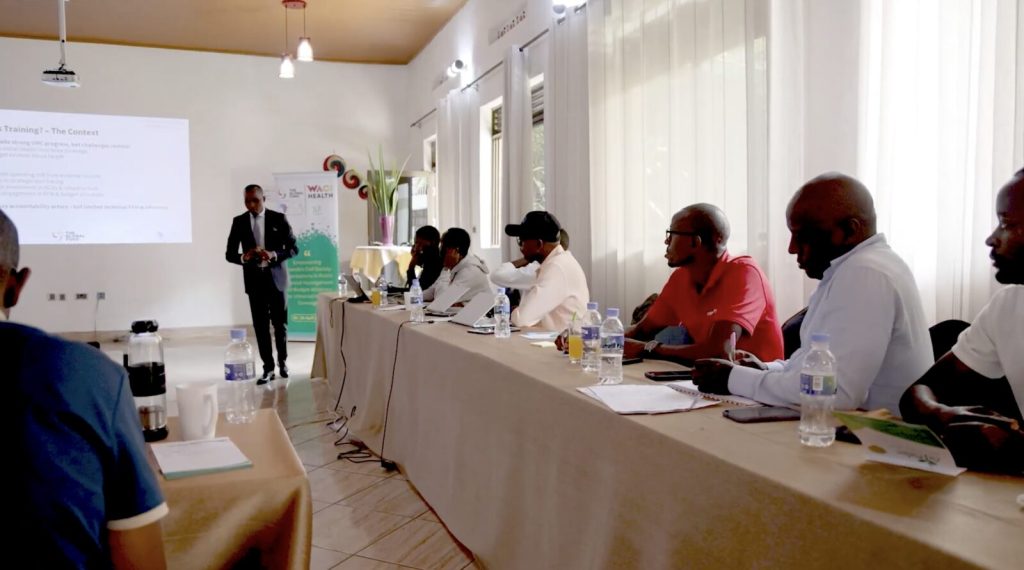
In April 2026, representatives from 21 health NGOs in Rwanda came together to work on exactly this.
🎥 Watch: Rwandan civil society takes on health budget analysis
Five days, two questions
The five-day training covered health budget analysis, the full PFM cycle from planning to audit, fiscal space assessment, and indicators for universal health coverage (UHC) and financial protection.
Two questions ran through the week:
- How can civil society make the case for a larger health allocation?
- How can it ensure that the allocation already committed is released on time and spent as intended?
A new national coalition
By the close of the training, participants had formed a national coalition. They elected Dr Moses Ahabwe of Building Systems for Health and Dr Marie Merci Cyuzuzo of Global Surgery Academic Support to coordinate it.
They also developed an advocacy agenda built around three priorities:
- Non-communicable diseases
- Mental health
- Maternal health and child development
Representatives from the Ministry of Finance and Economic Planning and the Ministry of Health Rwanda took part in the session. They gave participants direct insight into government budgeting processes and fiscal space realities.
About the Joint Learning Agenda
The training was part of the Joint Learning Agenda (JLA) on Health Financing, a capacity-strengthening initiative co-led by WACI Health and Impact Santé Afrique (ISA). It equips civil society organisations (CSOs) across Africa to engage in health financing and PFM advocacy.
Phases 1 and 2 reached more than 400 CSOs across 20 anglophone and francophone African countries. Phase 3 runs through December 2026 and extends the work to two more countries, bringing the total to 22. It builds on the structures already established:
- Quarterly capacity-strengthening bootcamps
- A digital Community of Practice platform
- A PFM toolkit built on the Conceptual Framework for Citizen and Civil Society Engagement, to strengthen civil society engagement in national budget processes
Why it matters
Governments need to apply rigorous PFM to execute and increase national health budgets and achieve UHC. There must also be avenues for CSOs to hold decision-makers to account. JLA Phase 3 equips civil society across 22 countries to engage at every stage of the budget cycle: to understand the documents, track the spending, and hold decision-makers to account.
When communities and civil society follow the money, health financing works harder for the people it is meant to serve.