“A woman’s survival should never depend on luck”: communities take maternal health to the media
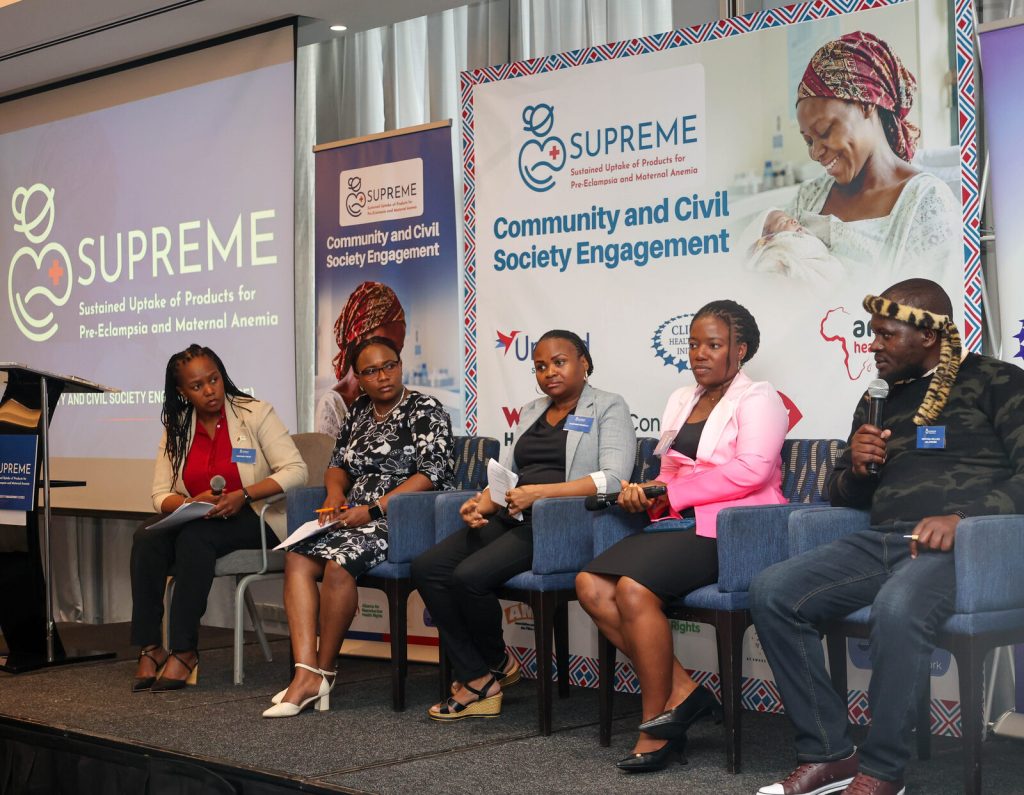
In late September, WACI Health brought together communities and civil society partners from Ghana, Kenya, Malawi, Senegal and Tanzania in Nairobi for the inception meeting of the SUPREME Community and Civil Society Engagement (CCSE) work. Over three days, partners built a shared plan for putting communities at the centre of efforts to end preventable deaths from pre-eclampsia and maternal anaemia. During the event, they also took their stories to the media, helping to increase awareness of these conditions.
Why this work matters
Hypertensive disorders of pregnancy, including pre-eclampsia, are the second leading cause of maternal death worldwide. Anaemia affects over a third of all pregnant women, and makes haemorrhage, pre-eclampsia, preterm birth and low birth weight more likely. Much of this harm can be prevented. Proven, low-cost medicines, diagnostics and devices already exist, yet they still fail to reach many of the women who need them.
SUPREME is a Unitaid-funded project that aims to introduce and scale up existing interventions and emerging innovations for the timely detection and treatment of pre-eclampsia and anaemia in pregnant women. It brings together two streams: SUPREME-Secure, led by the Clinton Health Access Initiative (CHAI) alongside Concept Foundation, the Aurum Institute, the Burnet Institute and WACI Health; and SUPREME-LIFELINES, led by Amref Health Africa with Jhpiego, Solthis and Market Access Africa. WACI Health leads the community and civil society engagement work.
Three days of learning, planning and co-creation
The meeting opened with community and civil society representatives joined by partners to build a shared understanding of SUPREME and the role of its Community Advisory Boards (CABs). Zuri Nzilani Foundation hosts the CAB in Kenya, joined by the Alliance for Reproductive Health Rights (ARHR) in Ghana, Malawi Health Equity Network, AMFE Sénégal (Association pour le Maintien des Filles à l’Ecole) and Thrive Beyond Preeclampsia Foundation (TPEF) in Tanzania.
CABs give the communities most affected a formal say in how the health products meant for them are developed, introduced and scaled up. Solutions shaped by clinical evidence alone risk missing the realities women face. As Joyce Nganga, Senior Policy Advisor at WACI Health, put it: “Projects come and go, but communities stay. That’s why we engage the community to ensure change is sustainable.”
Participants explored the evidence on pre-eclampsia and maternal anaemia, discussed how to embed gender-equitable approaches across the project, and considered how to build a movement for action on maternal health. Country teams then worked together to develop implementation action plans for their own contexts. Makena Katetei of Zuri Nzilani Foundation set the spirit of the room: “We must all be ambassadors for women. This is our time.” And as Rosemary Mburu, Executive Director of WACI Health, reminded participants in her opening, “The ultimate measure of our success will be the change that happens outside of the room, in our communities, impacting the lives of women and children.”
Letting communities tell their own stories
On the middle day, partners held a media roundtable in Nairobi, where people living with the gap between what exists and what reaches women spoke directly to journalists.
Catherine Kakolo Mongella, Chair and CEO of Thrive Beyond Preeclampsia Foundation, opened with words that set the tone: “No woman carries a pregnancy with the anticipation of not being able to leave the hospital with their child.” She described how pre-eclampsia ended in survival in one pregnancy and a stillbirth in another, when her symptoms were dismissed as a normal part of pregnancy. “I was literally fighting for my life while grieving the loss of my daughter,” she said.
Ruth Wangari Gitau, a pre-eclampsia survivor from Kenya, said that “a woman’s survival should never depend on luck, or on whether the nearest clinic happens to have what she needs.” Dr Ofosua Ehla from Ghana spoke about the power of women knowing their own blood pressure readings, and the need for reliable medicine supply and trained health workers, especially in rural areas. William Jalavikuba Munthali, a traditional leader from Malawi, described how poor roads and under-equipped clinics can turn a manageable complication into a tragedy.
Across these stories, the same gaps kept appearing: late detection, unreliable diagnostics, medicine stockouts, distance, cost, and too little community awareness of danger signs. A woman can know something is wrong and still not reach the care she needs.
What partners are calling for
Partners in SUPREME called on:
- Governments and funders to make maternal health an uncompromised budget priority.
- Product developers, manufacturers and regulators to deliver medicines and diagnostics that are rigorously tested, reliably supplied and affordable.
- Decision-makers to recognise, train and equip community health workers.
- All partners to treat women and communities as central partners in designing solutions.
You can read the full call in our press statement.
In the media
The roundtable drew coverage across print, radio, television and online outlets in English, Kiswahili, Luo and Kalenjin, taking these stories to audiences in Kenya and across the region.
NGOs warn of possible rise in maternal deaths, Citizen TV Kenya, 29 September
Read, watch and listen to more here!
- Preeclampsia’s Deadly Divide: When a Warning Sign Becomes a Lost Life, Health Business Magazine, 29 September
- Dwaro nitie mar medo pok mar yedhe ma konyo mine ma yach, Ramogi TV Kenya (Luo), 29 September
- Pregnant women should help design the medicines they use, advocates say, The Star, 29 September
- Pregnancy Under Pressure, KBC Radio, 30 September
- Civil society urges action on pre-eclampsia, maternal anaemia as Kenya loses 16 mothers daily, Citizen Digital, 30 September
- Pre-eclampsia: pregnancy complication stealing mothers and babies, The Standard, 30 September
- The pregnancies they survived — and the babies they could not save, The People Tribune, 30 September
- Pre-eclampsia survivors raise alarm over gaps putting mothers at risk, People Daily, 30 September
- Health NGOs Warn of Rising Maternal Deaths Over Inadequate Funding for Pre-Eclampsia, Aasai TV Kenya (Kalenjin), 30 September
- Pre-Eclampsia, Anaemia: Why Pregnant Women Are Still Dying From Preventable Conditions, KTN News Kenya, 3 October
- Kifafa cha mimba bado kinasababisha vifo vingi vya akina mama na watoto Afrika, RFI Kiswahili, 7 October
What happens next
The meeting is over, but the work has only just begun. Over the coming months, SUPREME country partners ARHR, Zuri Nzilani Foundation, Malawi Health Equity Network, AMFE Sénégal and TPEF will take these calls into communities and national decision-making spaces in Ghana, Kenya, Malawi, Senegal and Tanzania.
Together, we will keep putting the pressure on, so that every mother gets the care she needs.